The Books that Inspired Oscar Winning Movies: 2000-2025

And the Oscar goes to… books!

If the book is always better than the movie, then books that are adapted into Academy Award Best Picture winners must be darn good reads!
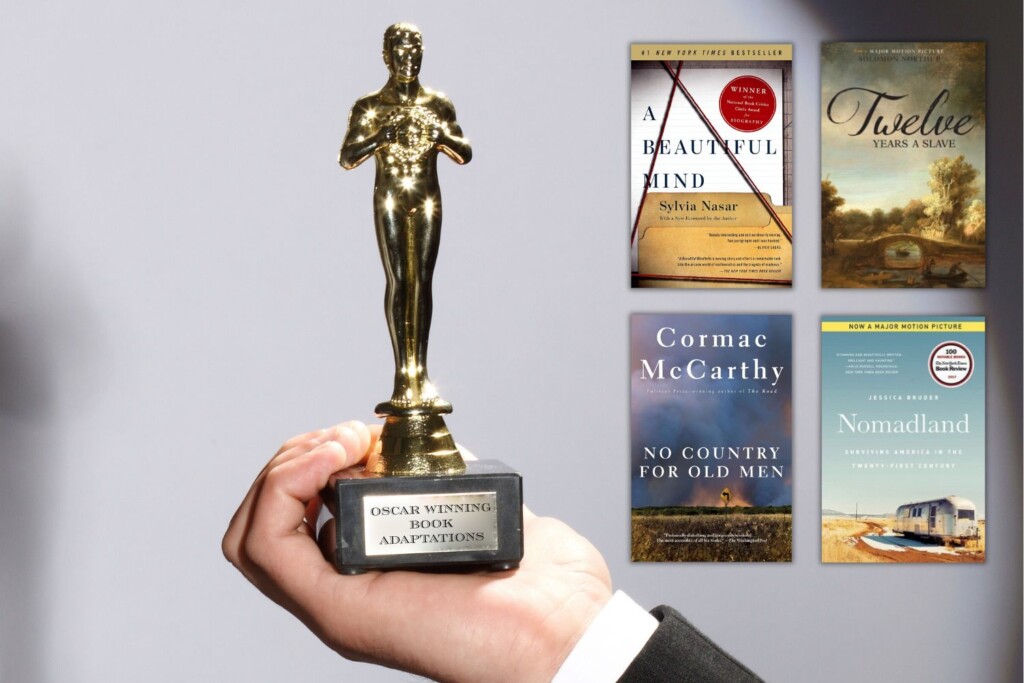
The Academy Awards date back to the 1920s, and over that time, many of the Oscar-winning films began as books. For our list below, we’ve focused on Best Picture-winning book adaptations during the 21st century, and we’ve included a brief look back at another twenty years (1980-1999).

But first, let’s take a look at the 2026 Best Picture nominees…

2026 Oscar-Nominated Movies Based on Books

The 2026 Best Picture winner will be revealed in March, but in the meantime, here are the books that inspired or were adapted into several of this year’s nominees:

  • Frankenstein – Adaptation of Frankenstein; or, The Modern Prometheus (1818) by Mary Shelley
  • Hamnet – Adaptation of Hamnet (2020) by Maggie O’Farrell
  • Train Dreams – Adaptation of Train Dreams (2011 novella) by Denis Johnson
  • One Battle After Another – Loosely based on/inspired by Vineland (1990) by Thomas Pynchon
  • Marty Supreme – Inspired by the life of 1950s table tennis champion and hustler Marty Reisman, specifically his 1974 memoir, The Money Player: The Confessions of America’s Greatest Table Tennis Champion and Hustler (Currently out of print).

Books Adapted into Academy Award Winning Films: 2000-2025
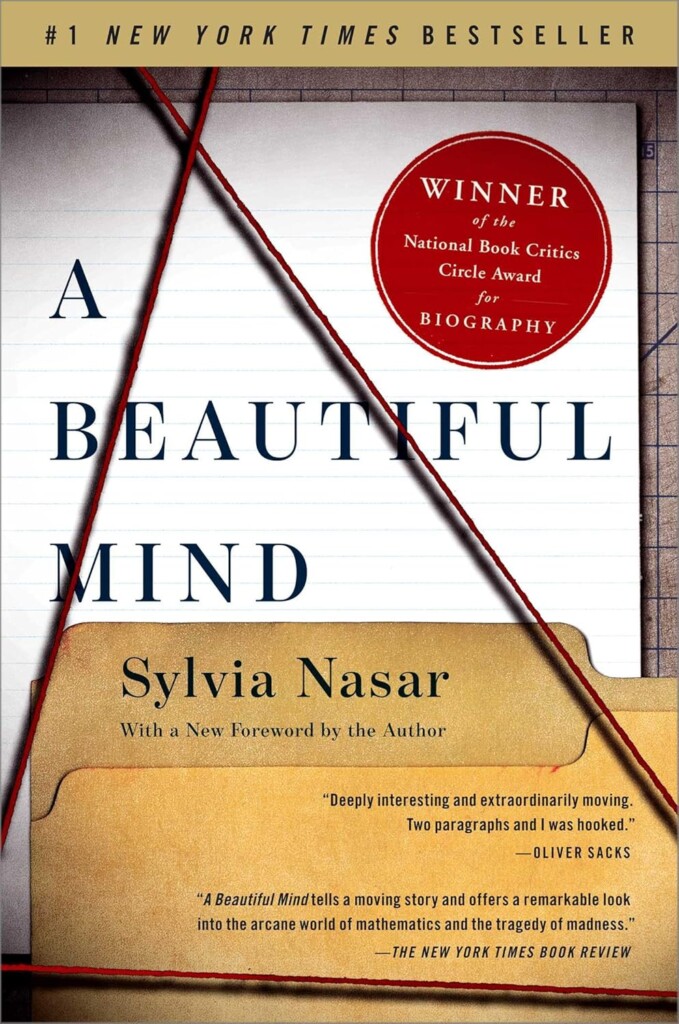
A Beautiful Mind book cover

Book Summary

This is the biography of John Nash, a brilliant mathematician whose groundbreaking work in game theory revolutionized economics. The book traces his journey from a curious and eccentric boy in West Virginia to a Princeton prodigy and MIT professor.

As Nash’s academic star rises, so does the impact of his untreated schizophrenia, which leads to years of delusions, hospitalizations, and personal turmoil. Despite these challenges, Nash gradually recovered and eventually earned the Nobel Prize in Economics in 1994.

About the Adaptation

This biography was adapted into a 2001 film directed by Ron Howard, which won both the Academy Award for Best Picture and Best Director.

The movie differs from the book by taking more creative liberties with the timeline and key events of Nash’s life. While the book focuses on Nash’s mathematics and mental health, the film takes a more inspirational tone, emphasizing love and redemption.

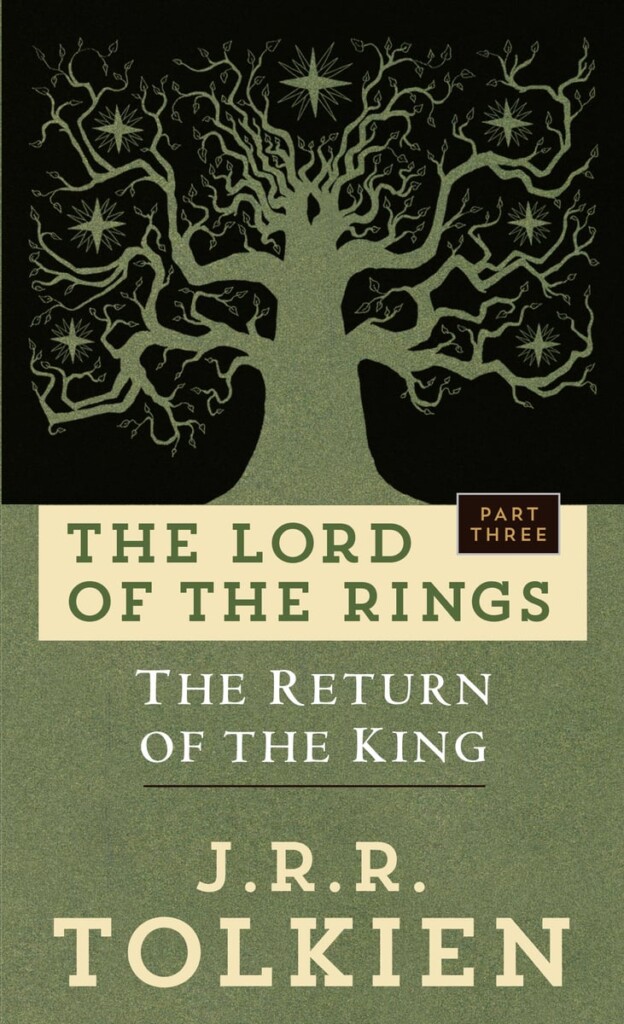
Return of the King book cover

Book Summary

The Return of the King is the third and final volume of The Lord of the Rings, the epic fantasy trilogy that continues the world introduced in The Hobbit and follows The Fellowship of the Ring and The Two Towers.

As the shadow of Mordor spreads, the members of the Fellowship are scattered—and every road leads toward war. In Gondor, the last great stronghold of Men braces for the Dark Lord’s assault, while Aragorn, revealed as the hidden heir, must choose the path that will decide whether a king will return. Far away, Frodo and Sam press deeper into Mordor on a mission that can end the conflict—or doom Middle-earth forever.

About the Adaptation

Peter Jackson’s The Lord of the Rings: The Return of the King film adaptation follows Tolkien’s main arc but with less of the book’s political texture. Most notably, the film omits “The Scouring of the Shire,” a major post-war chapter that reshapes what “home” means after the quest.

Kindle Unlimited as of: 01/18/2026
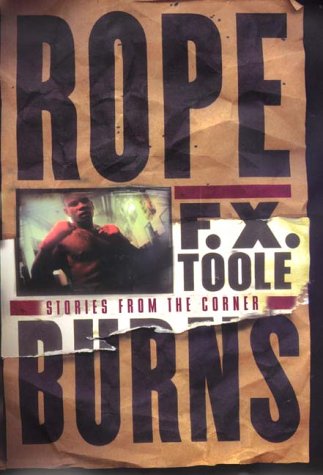
Rope Burns book cover

Book Summary

Drawn from the author’s own experience in boxing, Rope Burns is a collection of stories set inside the sweat-soaked, unforgiving world of professional fighting.

Across five stories and a novella, Toole introduces vivid characters whose ambitions, loyalties, and moral compromises collide under the brutal pressures of the sport and the business around it.

About the Adaptation…

This story collection served as the inspiration for the Oscar-winning film Million Dollar Baby. The movie expands one of Toole’s stories (“Million $$$ Baby”) into a full, character-driven narrative with more emotional backstory. The film softens some edges, while the book keeps a grittier, insider feel.

Kindle Unlimited as of: 01/18/2026
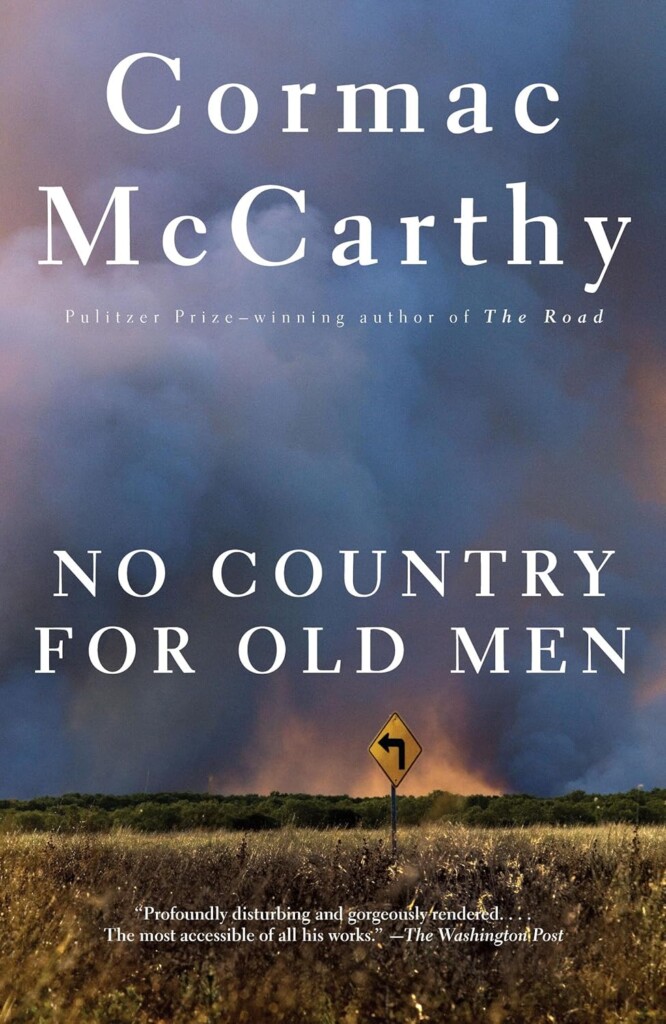
No Country for Old Men book cover

Book Summary

When Llewelyn Moss stumbles upon a drug deal gone wrong and takes off with a suitcase of cash, he becomes the target of Anton Chigurh, a remorseless hitman with a twisted moral code. As Sheriff Ed Tom Bell investigates the escalating violence, he reflects on a world that seems to have grown beyond his understanding.

Author Cormac McCarthy, who passed away in 2023, was a Pulitzer Prize-winning author known for his dark, sparse prose, minimal punctuation, and stark depictions of the American Southwest.

About the Adaptation

The Coen brothers’ film No Country for Old Men closely follows the book, preserving its plot and dialogue, and matching its bleak tone. The film relies less on interior monologue and philosophical reflection, especially those voiced by Sheriff Bell, and instead emphasizes visual restraint and long stretches of silence.

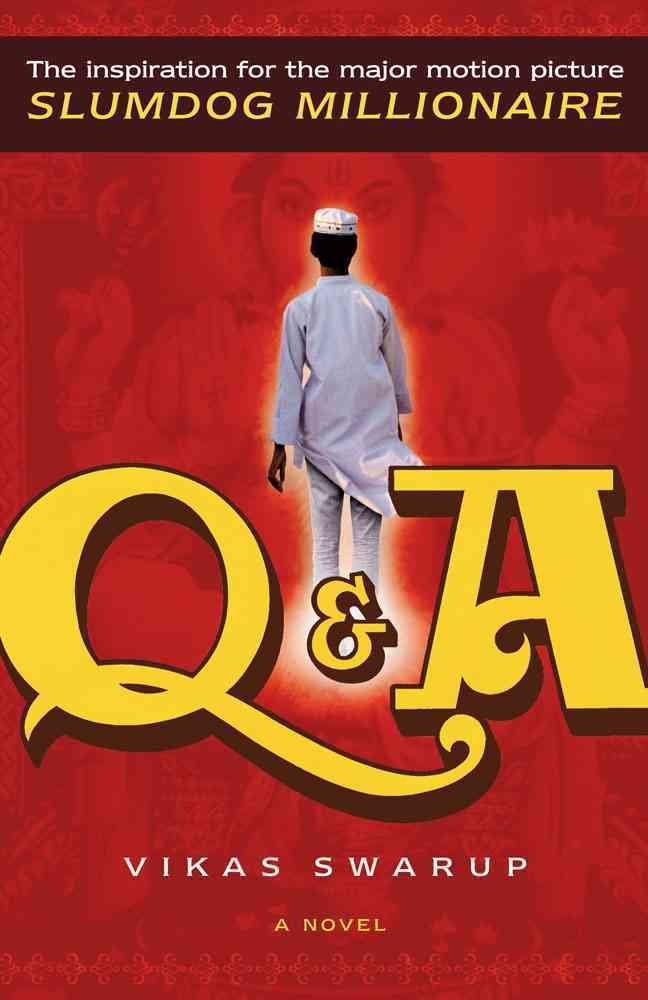
Q & A book cover

Book Summary

This novel opens in a jail cell in Mumbai, where Ram Mohammad Thomas is being held after correctly answering all twelve questions on India’s biggest quiz show, Who Will Win a Billion?

It seems impossible that a poor orphan who has never read a newspaper or gone to school could win—unless he cheated. To prove his innocence, Ram tells his lawyer the story of his life, revealing how a series of extraordinary, often accidental experiences taught him each answer.

His tale ranges from being found as a baby in a Delhi church’s clothes donation box to working for a faded Bollywood star, crossing paths with a security-obsessed Australian colonel, and reinventing himself as an “overly creative” Taj Mahal tour guide.

About the Adaptation

The film adaptation, Slumdog Millionaire, reimagines Q & A. While the book unfolds through episodic stories explaining each quiz answer, the film streamlines the structure. The novel offers broader social satire, whereas in the film, the backstories are simplified and the romance is given greater prominence.

Book Girls’ Readers Rate This Book

4.1 out of 5
92%
Would Recommend to a Friend

Book Summary

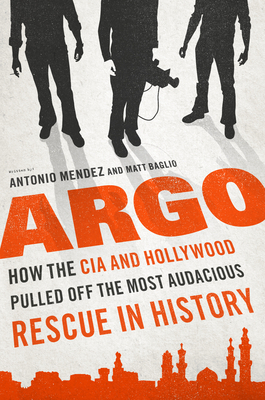
Argo tells the true story of the 1979 rescue of six Americans who escaped hostage capture in Iran. They were left hiding, hoping for escape. 

To get them out, CIA agent Antonio Mendez came up with an ingenious, but risky, plan. He would go undercover as a Hollywood producer scouting locations for a made-up science fiction film called “Argo.” Under this guise, Mendez and his colleagues successfully smuggled the six escapees out of Iran.

About the Adaptation

Ben Affleck’s Argo was primarily based on an article called “The Great Escape” by Joshuah Bearman. However, it also draws from Antonio Mendez’s memoir, The Master of Disguise, and heightens it for thriller momentum. Mendez and Baglio released the book Argo to coincide with the film’s release and provide more detail on the Tehran rescue operation.

The book provides additional background information, including context regarding the Iranian revolution, the embassy takeover, and the Iranian hostage crisis. The audiobook is highly recommended.

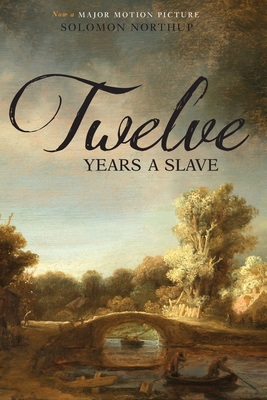
Twelve Years a Slave book cover

Book Summary

In 1841, Solomon Northup, a free Black man and musician from New York, is lured to Washington, D.C. with the promise of work. Then he is kidnapped, imprisoned, and sold into slavery. Sent south to Louisiana, he is forced onto plantations near the Red River, where he endures the daily realities of human bondage: violence, family separations, and the constant threat of punishment.

Over twelve years, Northup fights to survive without losing the truth of who he is, relying on resilience, skill, and cautious hope as he searches for any safe chance to get word to the people who can prove his freedom.

About the Adaptation

The 2013 film adaptation remains largely faithful to the memoir, while also making notable choices for cinematic impact.

The movie condenses timelines and merges minor figures to streamline the narrative, relying heavily on visual storytelling rather than Northup’s reflective prose. Violence and brutality are depicted more graphically on screen, emphasizing the physical realities the memoir describes in words.

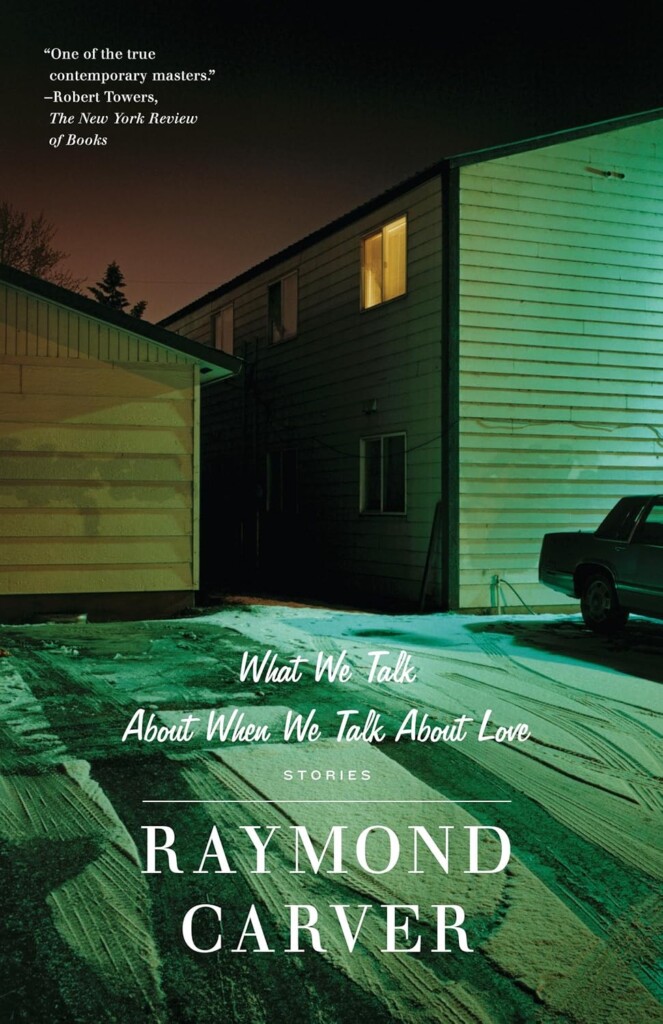
What We Talk About When We Talk About Love book cover

Book Summary

This is Raymond Carver’s landmark collection of seventeen stories about ordinary lives under pressure: marriages fraying, friendships faltering, and people reaching for connection when words don’t quite work.

In the title story, two couples sit together drinking gin and try to define what “love” really means, trading anecdotes that expose how desire, fear, and violence can blur into one another.

Together, all of these stories examine love and loss, loneliness and longing—and the fragile hope that understanding might still be possible, even when language fails.

About the Adaptation

While the 2015 Best Picture Winner Birdman is not a direct adaptation of Carver’s stories, the two are inextricably linked.

In Birdman, the main character is trying to reinvent himself by writing, directing, and starring in a stage version of Carver’s short story, “What We Talk About When We Talk About Love.” As a result, the themes of Carver’s story shape the film’s emotional DNA.

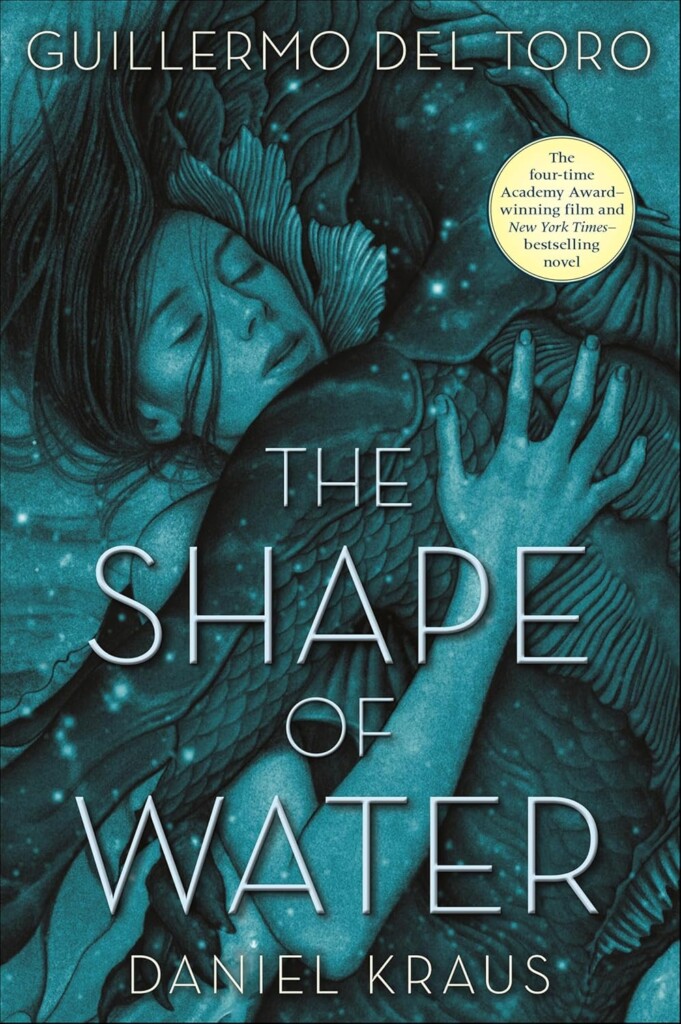
Shape of Water book cover

Book Summary

Elisa Esposito has mute her whole life. She was orphaned as a child, and now endures a lonely routine as a janitor on the graveyard shift at Baltimore’s Occam Aerospace Research Center. Her days are brightened only by Zelda, a protective coworker, and Giles, her kind neighbor.

Everything changes when Elisa discovers the facility’s newest “asset”: a mysterious amphibious creature held in captivity for research. As Cold War tensions mount and the creature’s fate grows more perilous, Elisa forms an unlikely bond that becomes both a refuge and a rebellion.

About the Adaptation…

This is not a standard book-to-film adaptation, but if you loved the movie, you’ll enjoy reading this alternate version of The Shape of Water

Daniel Kraus first had the idea for the story as a teenager. Years later, by then a successful author, Kraus had breakfast with filmmaker Guillermo del Toro to discuss a different book/film idea, but somehow the idea for The Shape of Water came up, and del Toro was immediately interested. 

The two went their separate ways, with del Toro beginning work on a different film project and Kraus beginning to develop his idea into a novel. What Kraus didn’t know was that del Toro was simultaneously working on a screenplay based on the concept.

Eventually, the pair decided to move forward with each telling the story in their own way. They would exchange phone calls and emails regularly to discuss the direction of their own versions of the story, but ultimately create two unique works.

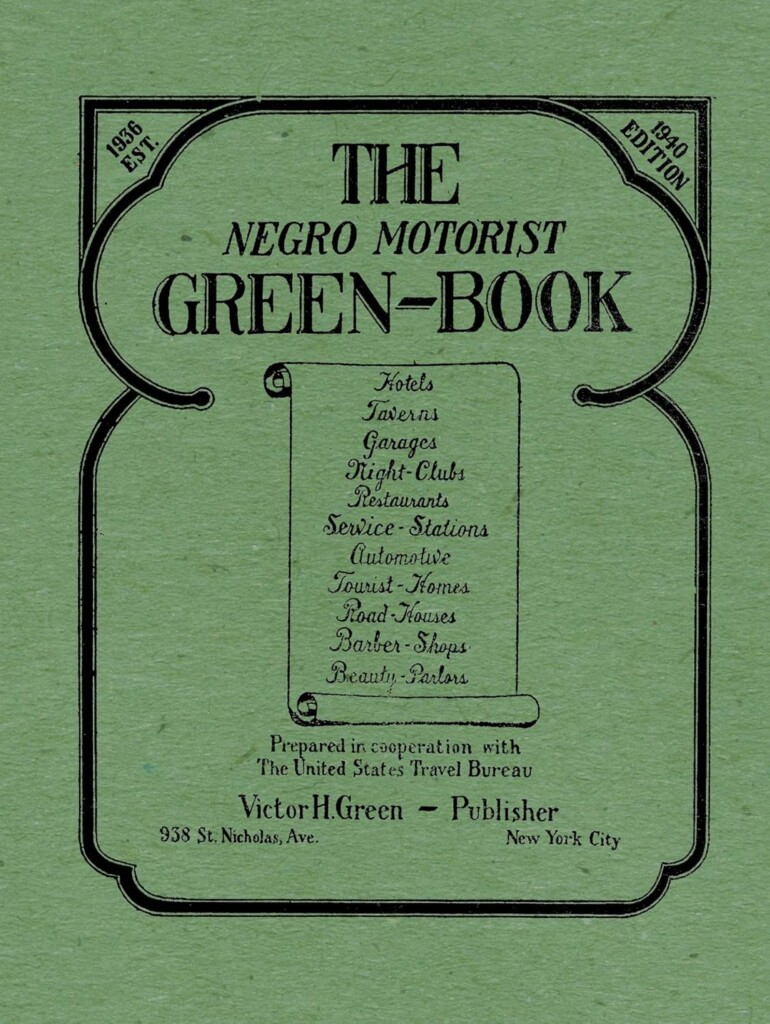
Negro Motorist Green-Book book cover

Book Summary

The Negro Motorist Green-Book is a series of annual travel guides created by Victor H. Green to help African American travelers navigate the United States during the era of segregation.

Published from 1936 into the 1960s, it listed businesses, such as hotels, tourist homes, restaurants, taverns, and service stations, that welcomed Black customers, offering practical information intended to also help travelers avoid “sundown towns”- towns that didn’t allow blacks to eat at their restaurants or rent hotel rooms.

Over time, the guide expanded beyond its earliest regional focus to cover a much broader geographic range, becoming a widely relied-upon directory for safer, more predictable travel.

Many issues are available to view online via the New York Public Library’s Digital Collections and the Library of Congress.

About the Adaptation…

The 2019 Academy Award-winning film Green Book uses the The Negro Motorist Green-Books as a narrative framework for a single road trip in the early 1960s. While the book functions as a practical directory created for widespread community use, the film focuses on personal relationships and individual experiences of segregation.

Book Girls’ Readers Rate This Book

3.8 out of 5
94%
Would Recommend to a Friend

Book Summary

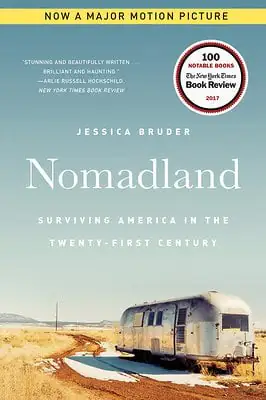
The Great Recession took an especially hard hit on older adults, many of whom lost their retirement savings. This nonfiction book tells the story of tens of thousands of seniors who formed nomadic communities, traveling from place to place in search of work in RVs and modified vans.

From the beet fields of North Dakota to the campgrounds of California to Amazon’s CamperForce program in Texas, employers have found creative ways to utilize this low-cost labor pool.

Context for This Book

Instagram is filled with influencers sharing curated photos of their nomadic adventures in glamorously decked-out RVs. This is not what Nomadland is about. This book tells the story of older Americans who are living out of their RVs and vans out of necessity rather than a sense of adventure. These are retirement-age adults who are essentially homeless and following seasonal work opportunities to make ends meet.

About the Adaptation

Chloé Zhao’s film adaptation of Nomadland shifts from a reporting style to an intimate portrait. While the book is a work of investigative nonfiction, profiling multiple older Americans living nomadic lives. The film centers on a single fictional protagonist and blends scripted scenes with real nomads playing themselves.

American Prometheus book cover

Book Summary

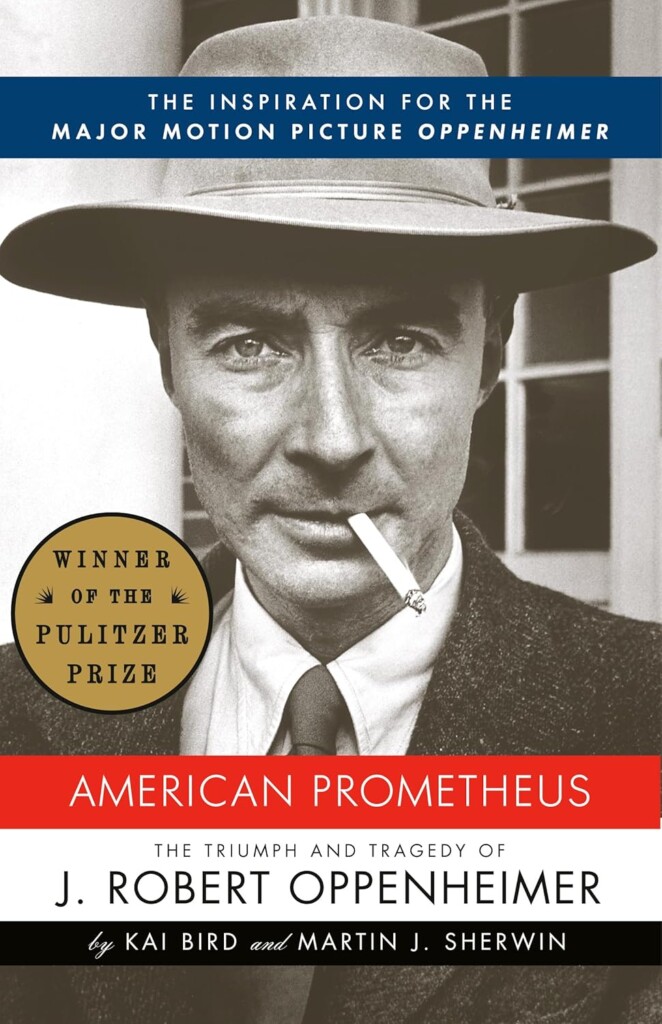
American Prometheus delivers a sweeping biographical portrait of J. Robert Oppenheimer, the brilliant, charismatic physicist who led the Manhattan Project and became known as the “father of the atomic bomb.”

Tracing his life and times from his early scientific rise to his central role in wartime America and the Cold War, the biography follows Oppenheimer’s ascent to fame and influence—then the unraveling of his public standing as political pressures, suspicion, and power struggles close in.

Both biography and history, the book examines the price of genius and the consequences of scientific progress, setting one man’s triumph and tragedy against an era transformed by nuclear weapons, secrecy, and ideology.

About the Adaptation

The film adaptation, Oppenheimer, takes a more stylized and compressed approach than American Prometheus. While the biography offers expansive historical context, multiple perspectives, and detailed political analysis, the film narrows its focus to Oppenheimer’s inner life and subjective experience.

Timelines are reshaped for dramatic momentum, and complex relationships and events are streamlined to fit a cinematic structure. The movie emphasizes tension, psychology, and moral ambiguity through visual and auditory storytelling, whereas the book provides a deeper exploration of motivations, ideologies, and long-term consequences.

Oscar-Winning Book Adaptations 1980 – 1999

  • 1980 Best Picture Winner – Ordinary People was adapted from the novel of the same name by Judith Guest.
  • 1983 Best Picture Winner – Larry McMurtry’s Terms of Endearment was adapted into a film of the same name.
  • 1984 Best Picture Winner – The film Amadeus is based on a book of the same title by Peter Shaffer. Shaffer was also a screenwriter for the movie.
  • 1985 Best Picture Winner – Karen Blixen’s 1937 Out of Africa was adapted into a film of the same name.
  • 1987 Best Picture Winner – The film The Last Emperor draws on the 1964 autobiography of Henry Pu Yi titled The Last Manchu.
  • 1988 Best Picture Winner – The film Rain Man was based on the true story of a man named Kim Peek. Born and raised in SLC, Utah, Kim’s dad, Francis, was a good friend of Book Girl Angela’s grandfather. In 1984, screenwriter Barry Morrow met Peek and was inspired to write the film. Later, in 1997, Francis wrote a book about his son called The Real Rain Man: Kim Peek.
  • 1989 Best Picture Winner – Driving Miss Daisy was based on a play of the same nameby Alfred Uhry.
  • 1990 Best Picture Winner – Michael Blake’s novel, Dances with Wolves, was adapted into a film of the same name.
  • 1991 Best Picture Winner – The filmThe Silence of the Lambs is based on the Thomas Harris novel of the same name, which is the second in his Hannibal Lecter series.
  • 1992 Best Picture Winner – Although the film Unforgiven was credited as an original screenplay by David Webb Peoples, Peoples has admitted that his screenplay was inspired by the book The Shootist.
  • 1993 Best Picture Winner – The film Schindler’s List was adapted from Thomas Keneally’s book that was originally titled Schindler’s Ark, but which is now published under the title Schindler’s List.
  • 1994 Best Picture Winner – Winston Groom’s novel, Forrest Gump, was adapted into a film of the same name.
  • 1995 Best Picture Winner – The film Braveheart was based on “The Acts and Deeds of the Illustrious and Valiant Champion Sir William Wallace,” the 15th-century poem by Henry the Minstrel.
  • 1996 Best Picture Winner – The English Patient by Michael Ondaatje was adapted into a film of the same name.
  • 1998 Best Picture Winner – Shakespeare’s Romeo & Juliet inspired the film Shakespeare in Love.

More Page-to-Screen Adaptations
Printable Version of this List

Our Inner Circle Members have access to a single-page printable version of the list of Oscar-winning book adaptations since 2000, along with other fun perks. Join now for instant access to the printable!

White printer on white desk with black computer screen reading Want to Print this List?

FIND YOUR PERFECT BOOK LIST

Comments on: The Books that Inspired Oscar Winning Movies: 2000-2025

Your email address will not be published. Required fields are marked *